

Converting dog years to human years is not as simple as multiplying by seven. Vets now use a size-adjusted formula: roughly 15 human years for a dog’s first year, 9 more for the second, then about 5 per year after that, since dogs mature fastest early in life and smaller breeds tend to age more slowly overall.
At Love Berners, dog years come up all the time, usually right after a family brings home a new Mini Bernese Mountain Dog or Tiny Bernedoodle and starts doing the math on how old their puppy really is. We love this question because the real science behind dog years is honestly more interesting than the old rule of thumb most of us grew up hearing.

Where the 7-Year Rule Came From
The idea that one dog year equals seven human years has been around since the 1950s, and it likely started from a simple comparison. People lived to about 70 on average, dogs lived to about 10, so someone divided 70 by 10, and the “multiply by 7” rule was born. It stuck around for decades, mostly because it was easy to remember, but it was never based on real science about how dogs actually age.
How Vets Actually Calculate Dog Years
The real picture of dog years is a lot more nuanced than a flat multiplier. According to the American Kennel Club, the first year of a medium-sized dog’s life is closer to 15 human years, the second year adds about 9 more, and every year after that adds roughly 5. Using this method, a 2-year-old dog is already about 24 in human years, and a 10-year-old dog lands closer to 59 rather than the 70 you would get with the old 7:1 ratio.
Why Size Changes the Math
One of the most important pieces of the dog years puzzle is size. Smaller and medium dogs, like the Mini Bernese Mountain Dog and Tiny Bernedoodle we raise here, tend to age more slowly and live longer than large breed dogs. VCA Animal Hospitals’ comparison of dog age to human age notes that small dogs are often not considered senior until 11 or 12, while giant breeds can reach that stage by 7. This is a big part of why there is no single, universal formula that works for every dog.
The Epigenetic Clock: A Newer, More Scientific Approach

Researchers have also studied dog years at the DNA level. A study published in Cell Systems and covered by the National Institute on Aging, part of the National Institutes of Health, looked at changes in dog DNA methylation over time, called an epigenetic clock, and found that an 8-week-old puppy lines up developmentally with roughly a 9-month-old human baby, while a 12-year-old Labrador lines up with about a 70-year-old person. Dogs age extremely fast in that first year or two of life before the pace slows down considerably. The Dog Aging Project, a long-running research initiative studying canine aging, continues to build on this kind of work to better understand how dogs age at the biological level.
What This Means for Everyday Care
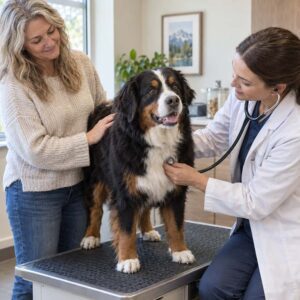
Understanding dog years is not just a fun fact; it actually shapes how we think about care at every stage. The AAHA Canine Life Stage Guidelines break a dog’s life into puppy, young adult, mature adult, and senior stages rather than relying on a single age cutoff, which matches how we think about puppy nutrition and long-term health here. The AVMA notes that this staged approach to aging also shapes how often a dog should see the vet as they get older. A 7-year-old Mini Bernese Mountain Dog is not nearly as “old” as the 7:1 rule would suggest, but genetic health testing early on, backed by our health guarantee, paired with regular checkups as a dog ages, does a lot more for a long, healthy life than any age conversion chart ever could.
A Note From Our Team
We have raised a lot of litters here, part of the story we share on our about page, and one thing we have learned watching puppy after puppy grow up is that age really is just a number until you look at the whole picture. Merck Animal Health notes that by the time a dog is a year or two old, they are already a teenager in human years, and just a few years after that they are considered middle-aged, which tracks closely with what we see in our own available puppies as they grow.
We always tell new families that dog-year conversions are a fun way to think about your dog’s stage of life, but the real markers we watch for- energy level, coat condition, mobility, and appetite- tell us far more about how a dog is actually aging than any formula does. If you have questions about your own dog’s life stage, our FAQ page and our contact page are always open, since every dog deserves a loving home, and every home deserves a loving dog, at any age.
Frequently Asked Questions
Is the 7-year rule ever accurate?
Not really. It is a rough estimate that does not account for the fast aging that happens in a dog’s first two years or the differences between breeds and sizes.
At what age is a dog considered a senior?
It depends heavily on size. Small and medium dogs are often considered senior around 10 to 12, while large breed dogs can reach that stage as early as 6 or 7.
Do smaller dogs really live longer than large dogs?
Yes, smaller and medium breeds generally have longer lifespans and tend to age more slowly than large or giant breeds.
How accurate is the epigenetic clock method?
It is scientifically interesting and based on real DNA changes, but the original study only used one breed, so it is not considered a universal formula for every dog.
Does breed affect how a dog ages?
Yes, different breeds age at different rates, which is exactly why any dog years conversion is only ever an estimate.